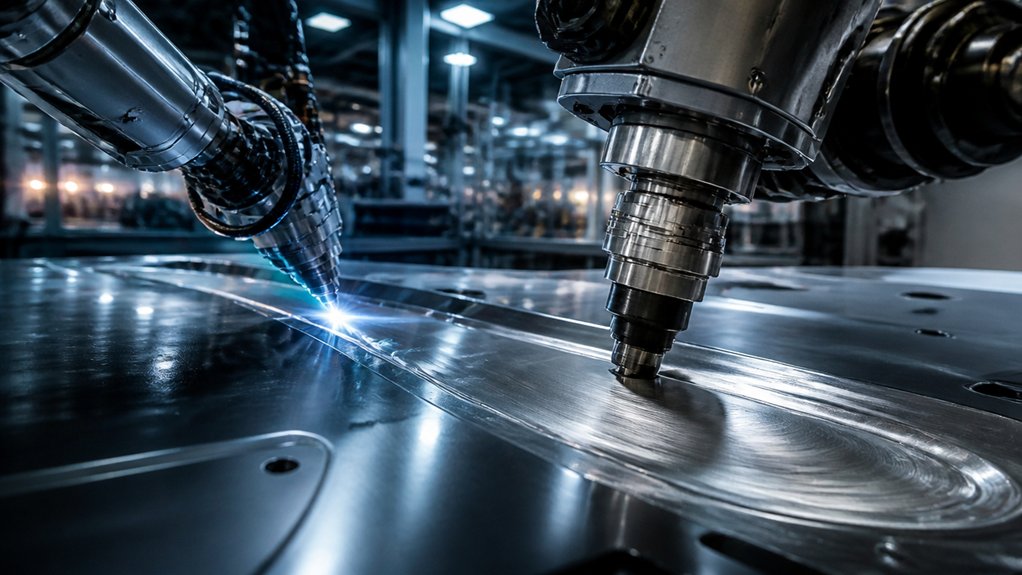
Laser welding and friction stir welding suit different metal parts, materials, and production needs. Laser welding melts metal with a focused beam of light, creating a narrow weld and a small heat-affected zone—the area around the weld whose properties change from heat. Friction stir welding uses a rotating tool to soften and mix metal without melting it, which can reduce distortion.
Laser welding is often used for stainless steel and aluminum parts with accessible, closely fitted joints. The process can support fast, automated production, but gaps, reflective surfaces, joint access, and fit-up can affect weld quality. Buyers should specify the material grade, thickness, joint design, and required inspection method.
Friction stir welding is used mainly for aluminum alloys, including some grades that are difficult to fusion-weld. It requires tool access along the joint and rigid support for the parts. The tool leaves an exit hole where it lifts from the work, so the part design must account for that feature or provide a way to remove it.
Selection depends on the alloy and thickness, joint geometry, production volume, and quality requirements. These factors also drive cost, including tooling, fixturing, automation, and inspection.
How Laser and Friction Stir Welding Work
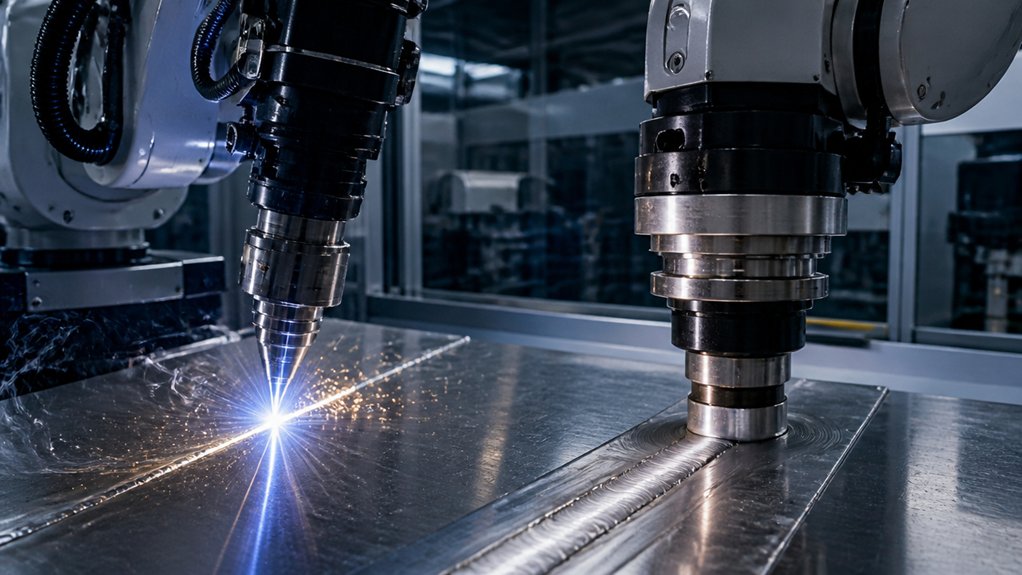
Laser welding joins metal by melting the edges with a focused beam, while friction stir welding bonds metal by stirring it in a softened, solid state. The choice depends on the alloy, joint design, thickness, production rate, and required weld properties.
In laser welding, a concentrated beam melts metal along the seam. The molten metal cools and forms the joint. A small heat-affected zone is the area beside the weld whose properties change from heat; it can help limit distortion. Power, travel speed, and beam focus affect penetration and bead shape. When briefing a supplier, specify the alloy and grade, thickness, joint geometry, and access for the beam. Confirm how weld penetration and defects will be inspected.
Friction stir welding uses a rotating, nonconsumable tool that doesn’t melt the workpiece. Its pin moves along the joint, stirring softened metal from both sides; the shoulder presses the material together behind the pin. The process is used for compatible alloys and joint designs, but tool access and clamping matter. Specify the alloy and grade, thickness, joint type, and required inspection. Tool rotation, travel speed, and downward force affect material flow and bond quality. Cost depends on setup, tooling, access, and production volume.
Which Welding Method Fits Your Job?
Laser welding fits jobs that need a narrow seam and limited heat distortion, while friction stir welding fits jobs that can accommodate a rotating tool and backing support. The right choice depends on the alloy and grade, joint shape, material thickness, production volume, and required strength.
Laser welding uses a focused beam to melt and join metal. It can suit stainless steel or aluminum parts with consistent joint fit-up, but gaps or misalignment can cause defects. Specify the joint design, access for the beam, and inspection method in the job brief.
Laser welding offers precise, low-distortion joints when fit-up, beam access, and inspection requirements are clearly specified.
Friction stir welding joins metal without melting it. A rotating tool presses and moves along the joint, so the part must allow tool travel and support beneath the seam. The process is often considered for aluminum alloys, but suitability depends on the alloy, temper, thickness, and joint geometry.
Ask suppliers to provide qualification data for the specified material and thickness. Compare strength, fatigue performance, defect limits, and inspection requirements. Also account for fixturing, equipment, operator skill, production rate, and repair options; these factors affect both process choice and manufacturing cost.
Where Are These Welding Methods Used?
Laser welding is used for thin, closely fitted parts in automotive body structures, battery enclosures, medical devices, and electronics. It joins metal with a concentrated laser beam, which can limit the area affected by heat and suit automated production. The result depends on the alloy, section thickness, joint fit-up, and access for the beam; reflective metals such as aluminum may need process adjustments.
Friction stir welding is used for long seams in aluminum aircraft panels, ship structures, rail cars, and vehicle frames. A rotating tool softens and stirs the metal without melting it, a method called solid-state welding. It can reduce distortion compared with fusion welding, but the part must be held firmly and the tool must reach the full joint. Joint layout and alloy condition affect suitability.
When briefing a supplier, specify the alloy and temper, material thickness, joint type, seam length, and production volume. Identify appearance, strength, leak-tightness, and inspection requirements. Ask how the proposed process will control fit-up, heat effects, and defects, and whether the part’s geometry allows the required beam or tool access. These details also affect fixture and tooling needs.
How Welding Improves Speed, Cost, and Quality
Laser welding and friction stir welding can improve production speed, cost control, and joint quality, but the gains depend on the material, joint design, and production volume. Laser welding uses a focused beam to melt metal along a narrow seam. Its fast travel can reduce cycle time, especially when automation keeps parts and beam settings consistent.
Laser welding can speed production and improve consistency, but results depend on the material, joint design, and automation.
Friction stir welding joins metal with a rotating tool that softens and mixes the material without melting it. A continuous pass can reduce finishing work on suitable joints.
The process choice affects cost through labor, filler metal, energy use, setup, inspection, and rework. For example, a buyer comparing laser welding and friction stir welding for aluminum plate should specify the alloy, thickness, joint geometry, required output, and acceptable surface condition. The best option depends on whether the part can accommodate the equipment and tooling each process requires.
To check quality, define the joint’s dimensional requirements and inspection method before production. Track cycle time, energy use, material consumption, and defects per part across production runs. Ask for records of process settings and inspection results; repeatable settings and controlled heat input can help limit distortion and produce consistent joints.
What Can Limit Laser and Friction Stir Welding?
Laser welding is limited by joint fit-up, material behavior, and access; friction stir welding is limited by tool access, clamping, and backing support. Fit-up means how closely the parts meet before welding. A gap or misalignment can disrupt laser penetration, especially in thin sheet or joints with changing thickness.
Reflective metals such as aluminum and copper can redirect laser energy, while surface condition and alloy composition affect how the metal absorbs heat. Shielding gas protects the weld from contamination, and sensors and motion controls must keep the beam aligned with the joint. These needs affect equipment, setup, and inspection requirements.
Friction stir welding uses a rotating tool to join metal without melting it. The tool must reach the seam, and a rigid fixture must hold the parts against the force of the process. The joint also needs backing support; tool wear and the tool’s exit hole at the end of a weld can affect quality. These limits depend on the alloy, part geometry, joint design, and production volume.
When briefing a supplier, specify the material and grade, thickness, joint geometry, access constraints, and required inspection. Ask how the proposed process will address fit-up, fixturing, weld-end conditions, and repeatability. Compare equipment, tooling, maintenance, and inspection needs over the planned production run.
Frequently Asked Questions
What Training Is Required to Operate Laser Welding Equipment?
Laser welding operators need laser safety training, instruction on the specific welding system, and supervised practice before working independently. The required training depends on the laser’s classification, the equipment manufacturer’s instructions, the materials being welded, and applicable workplace rules.
Laser safety training should cover hazards such as direct or reflected laser exposure, fumes, fire, and electrical risks. Operators should learn how to use required protective equipment, set up barriers and warning signs, and follow procedures for faults and maintenance. A laser safety officer (the person responsible for overseeing laser safety) may be required under applicable rules or workplace policy.
Equipment instruction should cover the machine’s controls, approved settings, workholding, focusing, and shutdown procedures. Supervised practice should include the actual materials and joint types in production, such as stainless steel sheet or aluminum parts. Employers should keep training records and retrain operators when equipment, materials, procedures, or safety requirements change. Certification is not universally required; verify whether a specific regulation, employer policy, or customer requirement calls for it.
What Safety Precautions Protect Workers During Laser Welding?
Laser welding safety depends on the laser’s wavelength and power, the equipment design, and the materials being joined. Use eye protection rated for the specific laser wavelength and operating conditions; ordinary safety glasses do not provide reliable protection from a direct or reflected beam.
Keep the beam enclosure closed during operation. An enclosure contains the beam, while an interlock—a safety device that stops or disables the laser when a guard is opened—helps prevent exposure. Use approved barriers and warning signs to restrict access, and verify that safeguards are in place before production starts.
Wear protective clothing suited to the work, including protection against hot metal and sparks. Welding stainless steel, aluminum, or coated sheet can produce fumes that require local exhaust ventilation, which captures contaminants near their source. The needed controls depend on the material, coatings, laser system, and ventilation design.
Before setup or maintenance, follow the machine maker’s lockout procedure. Lockout means isolating and securing energy sources so equipment cannot start unexpectedly. Production owners and engineers should check that operators are trained, safeguards are maintained, and the written procedure covers the specific laser and work area.
How Should Welded Joints Be Inspected After Production?
Inspect each weld visually, then use the nondestructive testing method required by the drawing, contract, or governing code. Visual inspection checks the weld surface and nearby base metal for visible problems, such as cracks, undercut, or an uneven profile. The inspector should also confirm that weld size and location match the drawing.
Nondestructive testing (NDT) looks for defects without cutting apart the joint. The suitable method depends on the joint design, material, thickness, access, and the defects of concern. Liquid penetrant testing can reveal surface-breaking flaws in nonporous materials. Magnetic particle testing can find surface and near-surface flaws in ferromagnetic metals, such as carbon steel. Ultrasonic testing and radiographic testing can examine some internal flaws; each has limits based on joint geometry and material.
Specify the acceptance standard before production, such as the applicable welding code or project specification. Record inspection methods, results, and any rejected areas. Require repairs to follow an approved procedure, then reinspect the repaired weld using the required method before accepting the part or releasing it for service.
Can Laser or Friction Stir Welding Be Automated?
Yes. Both laser welding and friction stir welding can be automated, but the equipment and controls must suit the part, material, joint design, and production volume.
Laser welding uses a focused beam of light to melt and join metal. Automation can coordinate the laser, motion system, and sensors that track the joint or monitor the weld. It is used on materials such as stainless steel, aluminum, and carbon steel; suitability depends on the alloy, thickness, joint fit-up, and access for the beam. Fit-up means how closely the parts meet before welding.
Friction stir welding joins metal with a rotating tool that presses and moves along the joint without melting the base metal. Automated systems control tool movement and force, making the process suitable for repeatable joints in materials such as aluminum. The part must be securely clamped, and the tool needs a path and access that the equipment can follow.
For either process, a production brief should identify the alloy and grade, thickness, joint geometry, required weld inspection, and expected output. These details determine whether automation is practical and what sensors, fixtures, and controls are needed.
What Maintenance Do Laser and Friction Stir Welding Systems Require?
Laser welding systems need regular cleaning of the focusing optics, inspection of cooling circuits, and checks of beam alignment. Dust or spatter on a lens can reduce beam quality, while poor cooling can affect the laser source and other components. Follow the equipment manufacturer’s instructions for cleaning methods and service intervals; the correct procedure depends on the laser type and optical design.
Friction stir welding systems need checks of the tool, spindle bearings, and workpiece clamping. The rotating tool’s pin and shoulder wear as they stir material, so inspect them for damage and replace them when wear affects weld quality. Check that the spindle runs smoothly and that clamps hold the parts firmly without shifting under load. The required checks depend on the alloy, plate thickness, tool design, and production rate.
For both processes, maintain the power source and verify control settings against the manufacturer’s specifications. Keep records of inspections, repairs, and calibration—the process of checking measurement or control accuracy against a known reference. These records help engineers connect maintenance issues with changes in weld quality or downtime.