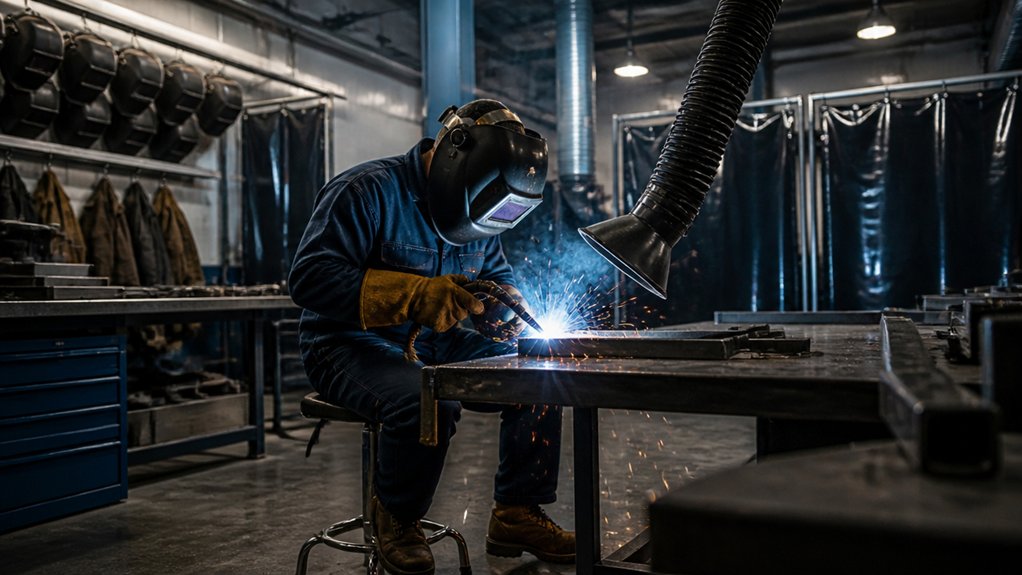
Before welding starts, verify the task-specific hazard controls, equipment condition, ventilation, and fire protection. The required controls depend on the process, base metal, filler metal, coatings, and work location; for example, welding stainless steel can produce hazardous fumes that require effective source capture.
Check that the welder has flame-resistant clothing, leather gloves, closed cuffs, and a helmet with a shade suitable for the process and current. Safety glasses should be worn under the helmet to protect against flying particles when the helmet is raised. Confirm that fume extraction captures smoke near the arc without disrupting shielding gas. If coatings or residues are present, identify them before work begins and determine whether they must be removed or need additional controls.
Inspect cables, connections, the work lead, and gas lines for damage or leaks. Keep combustible materials away from the work area, and confirm that suitable fire protection is available. For a production brief, specify the welding process, material and grade, joint location, coating condition, required ventilation, and inspection method. These details help the fabricator select controls and let the buyer check that the work plan addresses the actual hazards.
Choose Welding PPE for Burns and Arc Flash
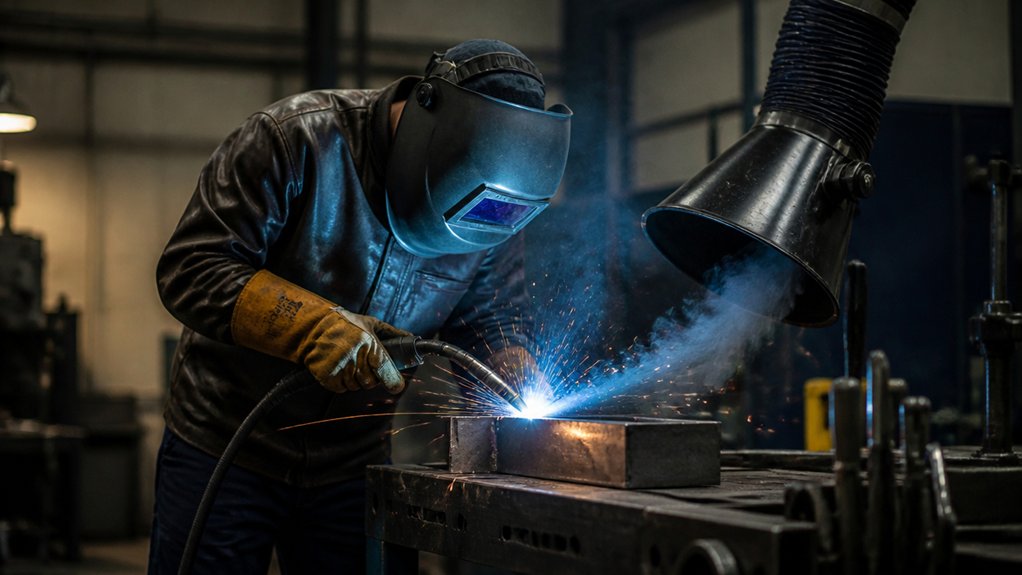
Choose welding PPE by process, welding current, and exposure—not comfort alone. Gas metal arc welding (GMAW) and shielded metal arc welding (SMAW) can expose workers to sparks, hot metal, and ultraviolet and infrared radiation. The required protection depends on the process, current, work position, and time spent near the arc.
For burn protection, specify flame-resistant clothing that covers the skin, leather gloves suited to the task, and leather boots. A welding jacket or sleeves can protect the arms and torso. Require closed cuffs and collars, covered pockets, and garments free of holes, frayed seams, or embedded contaminants. Avoid synthetic fabrics that can melt onto skin.
For arc exposure, select a helmet lens shade suited to the process and current. The American National Standards Institute (ANSI) standard ANSI Z49.1 provides guidance on welding safety and filter-lens selection; the required shade varies with the welding conditions. Check the lens, shell, and headgear before each shift, and replace damaged parts. The helmet must stay in position during work. Safety glasses worn underneath help protect the eyes when handling or chipping welds. Confirm that PPE is rated for the hazard and maintained according to its manufacturer’s instructions.
Protect Your Eyes and Lungs While Welding
Protect welders’ eyes with a helmet and safety glasses selected for the welding process, arc current, and applicable lens-shade requirements. Arc radiation includes ultraviolet and infrared energy, which can injure eyes and skin; the needed shade depends on the process and operating conditions. A welding helmet’s filter must be rated for the work, while safety glasses with side shields help block sparks and flying particles.
Keep the helmet down whenever the arc is active, and don’t rely on a raised helmet to protect against an arc flash. For respiratory protection, identify the base metal, coatings, filler metal, and work conditions before selecting a respirator. Welding stainless steel, for example, can produce different fume hazards from welding uncoated carbon steel, and removing coatings can create additional hazards.
Choose a respirator approved for the identified hazards, and check its fit, filters, and service life before use. Follow the respirator manufacturer’s instructions for replacement and maintenance. PPE (personal protective equipment) must fit the wearer and work with other gear. Keep eye and respiratory protection in place during welding and cleanup if fumes or airborne particles remain.
Control Welding Fumes at the Source
Place local exhaust ventilation near the welding arc to capture fumes before they spread. Local exhaust ventilation is a hood and fan system that draws contaminated air away from the welder. Keep the hood within the equipment manufacturer’s recommended capture distance, and move it as welding progresses along the joint. Position it so it doesn’t disturb shielding gas or interfere with the weld.
Specify a system suited to the welding process, base metal, consumables, and production rate. For example, fume extraction needs can differ between gas metal arc welding on carbon steel and gas tungsten arc welding on aluminum. Check airflow at the hood, where fumes enter the system, rather than relying on the fan’s rated airflow alone. Replace filters according to the manufacturer’s service guidance and pressure-drop readings; pressure drop is the change in air pressure across a filter that can indicate clogging.
Inspect ducts for deposits that restrict airflow, and clean or replace components as needed. If a hood can’t be positioned close enough to the arc, consider a fume-extracting gun or a portable extraction unit suitable for the process. Recheck capture when the workpiece, fixture, or welding position changes. General room ventilation can dilute contaminants, but shouldn’t replace source capture.
Prevent Welding Fires and Electrical Hazards
Before shielded metal arc welding (SMAW), gas metal arc welding (GMAW), or another welding process, remove combustible materials and shield nearby surfaces from sparks and hot metal. Check the far side of walls, floors, and partitions because sparks can pass through openings and ignite hidden materials. Don’t weld near flammable liquids, vapors, or combustible dust unless the hazards have been removed or controlled under the site’s fire-safety procedures.
Keep suitable fire-extinguishing equipment accessible, and make sure workers know how to use it. The required precautions depend on the welding process, nearby materials, and the work area. For example, welding galvanized steel can produce zinc-containing fumes, so the job also needs controls for fume exposure.
Before work begins, inspect welding leads, the electrode holder, the ground clamp, and power connections for damaged insulation or loose fittings. Replace defective parts. Keep gloves and clothing dry, use a dry work surface, and avoid welding in wet conditions or where conductive surfaces raise the risk of electric shock. Disconnect power before servicing equipment. Specify and check electrical protection that’s suitable for the welding power source and installation; the required protection depends on the equipment and applicable electrical codes.
Follow a Safe Checklist on Every Welding Job
Before welding, confirm the work order, base metal, filler metal, welding process, and approved welding procedure specification (WPS), the document that sets out how the weld must be made. Check that the material grade and thickness match the drawings and that the filler metal is compatible with the base metal. Verify machine settings and consumables against the WPS, and inspect the welding equipment for damage.
Check that the welder’s helmet, gloves, jacket, footwear, and respirator fit properly and have no damage that could reduce protection. Confirm that local exhaust ventilation, which captures fumes near their source, is positioned to remove fumes from the work area. Clear trip hazards and combustible materials, keep unauthorized people away, and secure the workpiece.
Inspect welding leads and connections, and confirm the return clamp—the connection that completes the electrical circuit—is attached securely to the workpiece or an approved nearby point. Review communication signals, emergency stops, and the location of fire-response equipment with the people involved. Use a brief reminder such as “pause, verify” to prompt the checks. Record any deficiencies and correct them before welding begins; if a requirement is unclear, resolve it against the drawing, WPS, or applicable safety procedure.
Frequently Asked Questions
What Welding Processes Are Best for Beginners?
Metal inert gas (MIG) welding is usually the easiest process for beginners to learn on clean, thin carbon steel, while flux-cored arc welding can suit outdoor work. MIG feeds a wire electrode through a gun and uses shielding gas to protect the weld; flux-cored wire contains ingredients that create shielding as it melts.
For a production brief, specify the metal grade, thickness, joint design and service conditions. For example, a joint in mild carbon steel may call for a different wire and procedure than one in 304 stainless steel. The right process also depends on access, production volume, surface condition and whether the work can be protected from wind.
MIG generally produces less slag, the solid residue left by welding, so cleanup is often simpler. Flux-cored welding can be more practical where wind would disturb MIG’s shielding gas, but it may leave slag that must be removed and checked. Ask the fabricator to identify the welding procedure and filler metal, and to state how the finished joint will be inspected. Follow the equipment manufacturer’s instructions and use appropriate eye, skin and fume protection during practice.
How Often Should Welding Equipment Be Inspected or Replaced?
Inspect welding equipment before each use, check wearable personal protective equipment (PPE) every shift, and replace any damaged or unreliable part before work resumes. The service interval for deeper maintenance depends on the equipment, process, duty cycle, and manufacturer’s instructions.
Before welding, check the power source, cables, connectors, torch or electrode holder, gas hoses, and regulators for damage, loose connections, leaks, or abnormal wear. Inspect helmets, gloves, protective clothing, and safety footwear each shift; remove items that no longer provide the protection specified by their manufacturer. Do not use a cracked helmet lens, a leaking gas hose, or a cable with exposed conductors.
Follow the manufacturer’s maintenance schedule for each machine and keep a record of inspections, repairs, and replaced parts. A monthly documented review can help track recurring faults, but it does not replace checks before use or service intervals set by the manufacturer. Reassess fume extraction and ventilation—the systems that capture or remove welding fumes—when the welding process, material, production rate, or work-area layout changes. The required controls depend on the metal being welded, consumables, task, and exposure assessment. Replace equipment when it cannot be repaired safely or no longer meets its specified operating requirements.
What Training or Certifications Do Welders Need?
Welders need training and qualification for the welding process, material, and joint used on the job; the required credentials depend on the product, applicable code, and employer. A welding procedure specification (WPS) is a written instruction that sets out how to make a weld, including the process, base metal, filler metal, and joint details. A welder may need to pass a qualification test showing they can follow that procedure.
For work governed by a code, check which code and qualification rules apply before production. The American Welding Society (AWS) publishes standards such as AWS D1.1 for structural steel, while pressure equipment may fall under the American Society of Mechanical Engineers (ASME) Boiler and Pressure Vessel Code. Requirements vary by process—for example, gas metal arc welding (GMAW) or gas tungsten arc welding (GTAW)—and by material, thickness, position, and joint type. Ask for the applicable WPS and records of welder qualification when reviewing a supplier’s plan.
Training should also cover hazards specific to the work, including welding fumes, ultraviolet radiation, hot metal, and electrical risks. Confirm that the employer provides suitable personal protective equipment (PPE), ventilation, emergency-response instruction, and refresher training as required by workplace rules.
How Should Welding Machines Be Maintained Between Jobs?
Between welding jobs, switch off and disconnect the machine from its power source before inspecting or cleaning it. Check the welding leads, torch, work clamp, and cooling lines for cuts, loose connections, leaks, or other damage; replace faulty parts before the next use.
Remove dust and metal spatter from the machine’s vents and surrounding surfaces so airflow is not blocked. Spatter is molten metal that has cooled and stuck to a surface. Use the cleaning method and materials specified in the machine manufacturer’s manual, and do not open the power source unless the manual permits it and the person doing the work is qualified.
Maintenance needs depend on the welding process, duty cycle (the share of time a machine can weld before it needs to cool), and shop conditions. For example, a machine used for frequent MIG welding in a dusty shop may need more frequent checks than one used occasionally in a clean area. Follow the manufacturer’s maintenance schedule, record inspections and repairs, and verify that the machine is ready for the next job.
Can Welding Be Performed Outdoors in Windy Conditions?
Shielded metal arc welding (SMAW), also called stick welding, can be performed outdoors in wind because its flux-coated electrode produces shielding gas and slag around the weld. Gas metal arc welding (GMAW), or MIG welding, and gas tungsten arc welding (GTAW), or TIG welding, rely on shielding gas supplied through a nozzle; wind can disperse that gas and cause porosity, or gas pockets in the weld.
For GMAW or GTAW on carbon steel, stainless steel, or aluminum, the decision depends on wind at the arc, joint access, and the shielding-gas and equipment manufacturers’ instructions. A windbreak can help, but it must not create a fire or fume hazard. Ask the fabricator to document the process, base-metal grade and thickness, filler metal, shielding gas, and any procedure qualification required by the governing welding code. A qualified welding procedure is a documented set of parameters shown to produce an acceptable weld.
Check that the work is dry and free of contaminants, the windbreak is secure, and the welder’s protective equipment suits outdoor exposure. Stop work if wind disrupts shielding, the arc becomes unstable, or conditions make the work unsafe. Acceptance should be based on the specified inspection method and applicable code, not appearance alone.