
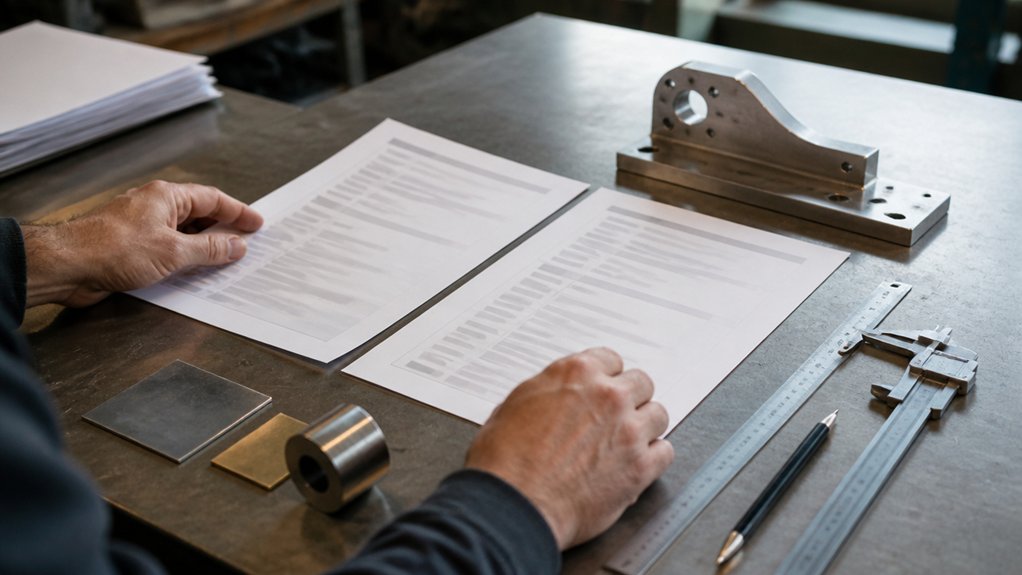
Compare fabrication quotes only after confirming that each covers the same drawing revision, part quantity, material, and scope. A drawing revision is the dated or numbered version that defines the part’s dimensions and features. Check whether the quote includes cutting, forming, welding, machining, finishing, and assembly where the job requires them.
Compare the specified material by grade and thickness, not just by name. For example, “stainless steel” does not identify whether the part calls for 304 or 316 stainless steel. Confirm that quantities, tolerances, and inspection requirements match the drawing and purchase specification. A tolerance is the permitted variation from a dimension; its effect on cost depends on the feature, process, and measurement method.
Check how each supplier plans to make the part. Laser cutting, waterjet cutting, and plasma cutting suit different materials and edge requirements; press-brake forming and machining also have different setup and production needs. Ask whether tooling, deburring, coatings, packaging, and freight are included, and note minimum charges, quote expiration dates, and assumptions about material availability or drawing interpretation. A lower total may omit a required operation or rely on an assumption that changes the finished part.
Match Fabrication Quotes on Scope and Drawings

Before comparing prices, confirm that every fabricator quoted the same work from the same drawing revision. A drawing revision is a dated or numbered version of the design; different revisions may change dimensions, materials or manufacturing requirements. Check each quote against the request for quotation (RFQ), drawings and written clarifications.
Compare the listed parts, processes and requirements. For example, confirm whether the work includes laser cutting, press-brake forming, welding, machining, surface finishing, inspection and delivery. Check that the material grade and thickness, dimensions, tolerances (permitted variation), finish and inspection records match the RFQ. Requirements depend on the part’s function, mating components and service conditions, so don’t assume that a general note covers every detail.
Ask each fabricator to state which drawing revision they used and list exclusions, assumptions and deviations. An exclusion is work left out of the quote; an assumption is an unstated condition the quote relies on. Resolve conflicting notes, sections or detail views in writing, then send the same clarification to every bidder. This helps distinguish a genuinely more efficient proposal from one that leaves out required operations or deliverables, and reduces the risk of later changes caused by different interpretations.
Compare Materials, Grades, and Quantities
Check that every quote specifies the same alloy or steel grade, temper, thickness, product form, and quantity. Product form means the shape supplied, such as plate, tube, or bar; temper describes a metal’s condition after processing, which can affect its properties. Confirm any required material certificates, which document the material’s grade and properties.
A grade substitution can change strength, corrosion resistance, weldability, or availability, so require approval before treating alternatives as equivalent. Check each line’s unit and total quantity, including cut lengths, nesting assumptions (how parts are arranged on stock), and expected scrap. For example, compare the same plate dimensions in inches (millimetres) and account for whether the supplier is quoting full sheets or cut blanks.
Compare quoted material costs using benchmarks for the specified grade and form. Broad commodity indexes may not reflect certified or specialty stock. Check whether freight, surcharges, and minimum-order charges are included consistently, and ask what explains a substantially lower quote. Differences may reflect a substitution, stock condition, or quantity break. Also note whether the material has limited supply sources, which can increase lead-time and availability risk. Record each variance before comparing totals or requesting revisions.
Compare Labor, Tolerances, and Production Methods
Compare labor by separating programming, setup, machining, welding, and finishing, then check that each quote uses the same production method and drawing requirements. This makes differences in labor and manufacturing effort easier to identify than a single total.
Programming prepares tool paths or machine instructions; setup positions and secures the material before production. Ask whether the part will be cut by laser, plasma, or waterjet, machined on manual or CNC equipment, and welded by hand or with automated equipment. CNC means computer numerical control: programmed instructions guide the machine. The suitable method depends on the part’s geometry, material, batch size, and required repeatability.
Compare production methods and labor carefully; geometry, material, batch size, and repeatability determine the suitable approach.
Check each quoted tolerance, the permitted variation in a dimension, against the drawing. Pay particular attention to holes, mating surfaces, and other critical interfaces. Tighter tolerances can require slower machining, extra setups, or additional inspection. Confirm that every shop has allowed for the same material grade and thickness, machining and welding processes, and finishing steps.
Also check assumptions about batch size, tooling, inspection, and rework. Tooling means fixtures or other equipment used to hold or shape a part. Ask for clarification when a process, tolerance, or operation is missing or listed as an exclusion.
Compare Quality Checks and Delivery
Compare each metal fabrication quote by listing its inspection methods, measurements, and records, then check delivery commitments against your required receipt date. A dimensional report records measured features against the drawing; a material certificate identifies the supplied metal and its stated grade. For welded parts, ask whether the quote includes visual weld inspection or another specified inspection method.
Check that suppliers use the same acceptance criteria: the rules for deciding whether a part passes. Confirm which features are measured, how often inspections occur, and whether reports identify the drawing revision used. Requirements depend on the part’s function, material, process, and consequences of failure. For example, a load-bearing steel weld may need different inspection and records from a nonstructural sheet-metal cover. Don’t assume a list of checks covers every critical feature.
Compare quoted lead times, shipment milestones, packaging, and responsibility for transport. Ask whether the schedule includes inspection, any required rework, and release of documentation before dispatch. Check that each timeline assumes the same quantity, material grade, thickness, and production sequence. Record quality requirements separately from delivery terms; different inspection levels or schedule assumptions can explain why quotes don’t cover equivalent work.
Check Fabrication Quote Fees and Expiry
Before approving a metal fabrication quote, check which charges it includes and when the offer expires. Ask the supplier to list tooling, setup, inspection, packaging, freight, taxes, and surcharges separately. Tooling means the fixtures or dies needed to make the part; setup covers preparing the machine and process. Confirm whether the quoted amount covers the full order quantity or whether a minimum-run charge applies.
Compare the same scope across quotes. For example, a quote for laser-cut 304 stainless steel sheet may exclude deburring, the removal of sharp edges, while another includes it. Check whether material grade, thickness, finish, tolerances, and inspection requirements match your drawing and purchase specification. These details affect both the work required and the final delivered cost.
Check the expiry date and the assumptions behind the quote, such as material availability, exchange rates, and production capacity. After expiry, the supplier may change the price or lead time. If approval will take longer, request a written extension before the deadline. Record the accepted price, included services, exclusions, and validity period in the purchase order or other purchasing record.
Frequently Asked Questions
How Many Fabrication Quotes Should I Request?
Request three fabrication quotes, using the same drawing, material specification, and delivery requirements for each supplier. Matching the scope makes it easier to compare price, lead time, and whether each proposal covers the same work.
For a sheet-metal part, specify the alloy and grade, thickness, finish, and forming or cutting process, such as laser cutting and press-brake bending. For a welded assembly, include the drawing, weld locations, inspection requirements, and any required welding procedure or certification. State the delivery date and whether packaging, finishing, or freight is included.
Compare more than the quoted total. Check assumptions, exclusions, proposed material substitutions, tooling charges, and the supplier’s stated production schedule. A fourth quote can help if the first three differ substantially, leave important requirements unclear, or suggest that suppliers interpreted the drawing differently. The right number also depends on part complexity, production volume, and how many qualified suppliers can meet the specification.
What Information Should I Provide When Requesting a Quote?
Provide a dimensioned drawing, material and grade, quantity, manufacturing process, finish, and inspection requirements. A dimensioned drawing shows the part’s measurements and features; identify the units and mark which dimensions are critical. State the material grade, such as 304 stainless steel, and thickness, rather than specifying only “stainless” or “sheet metal.” Name the required process, such as laser cutting, press-brake forming, or MIG welding, if it is known.
Specify tolerances—the permitted variation from a stated dimension—and explain which features must meet them. Include the finish, such as powder coating or a specified surface texture, and any required certifications or inspection records. If a standard or drawing governs these requirements, name it and provide the relevant revision.
Also state the delivery location, requested delivery date, packaging needs, and quantity per order. Identify acceptable material or process substitutions, or say that none are allowed. These details help suppliers assess material use, setup, processing, inspection, and shipping requirements consistently. When a requirement is undecided, label it as an open question rather than leaving suppliers to make different assumptions.
How Long Does a Fabrication Quote Usually Take?
A fabrication quote usually takes one to five business days, depending on the process, design complexity and completeness of the request. A straightforward laser-cut steel plate may be priced sooner than a welded assembly that needs several operations and material sourcing.
The quote depends on clear drawings and specifications. Include dimensions in inches (millimetres), material type and grade, thickness, quantity, finish, and any required tolerances—the permitted variation in a dimension. For sheet metal, identify the forming and cutting operations; for a weldment, show joint details and weld requirements. If a drawing omits information, the fabricator may need to ask questions before estimating labor and material.
Longer lead times are more likely when a design needs engineering review, custom tooling, multiple processes, or material that is not readily available. Comparing quotes can also take extra time if suppliers interpret the drawings differently. A buyer can check that each quote covers the same scope, material specification, quantity, finish, and delivery terms before comparing them.
Can I Negotiate a Fabrication Quote?
Yes, you can negotiate a metal fabrication quote, but compare the scope before asking for a lower total. Check that the drawing, material grade, thickness, tolerances, quantity, finish, inspection requirements, and delivery schedule match your needs. A tolerance is the permitted variation from a specified dimension.
Ask the fabricator to explain the main cost drivers. These may include cutting method, such as laser cutting or waterjet cutting; forming and welding time; setup for a small production run; material waste; finishing; and inspection. The best options depend on the part’s geometry, required strength, appearance, and production volume.
You can ask whether a design change would reduce operations, whether a different material grade or thickness meets the engineering requirements, or whether combining orders would improve production efficiency. Do not accept a substitution without checking its effect on strength, corrosion resistance, fit, and applicable specifications.
Request a revised, itemized quote that identifies any changes to materials, processes, tolerances, finish, or delivery. Compare the revised scope with the original before making a decision.
What Should I Do if a Quote Is Significantly Lower Than Others?
Do not accept or reject a significantly lower quote until you have compared its scope with the other bids and asked the supplier to explain any differences in writing. A low figure may reflect a different process, thinner material, fewer finishing steps, or exclusions such as packaging and delivery—not necessarily a better deal.
Check that each quote names the same alloy and material grade, stock form, and thickness. For example, a quote for 304 stainless steel sheet is not directly comparable with one for 316 stainless steel sheet. Confirm the part dimensions, quantity, drawing revision, and tolerances—the permitted variation in a dimension. Ask whether the price includes cutting, bending, welding, machining, surface finishing, inspection, and any required certificates.
Compare the stated process and acceptance criteria. A laser-cut edge, for example, may need different finishing from a sheared edge, depending on fit and appearance requirements. Check which items are excluded, who supplies the material, and whether delivery, packaging, or tooling is included. Ask the supplier to explain unusual assumptions and confirm any changes in a revised written quote. Then compare the complete scopes, relevant references, and ability to meet the required schedule before deciding.