
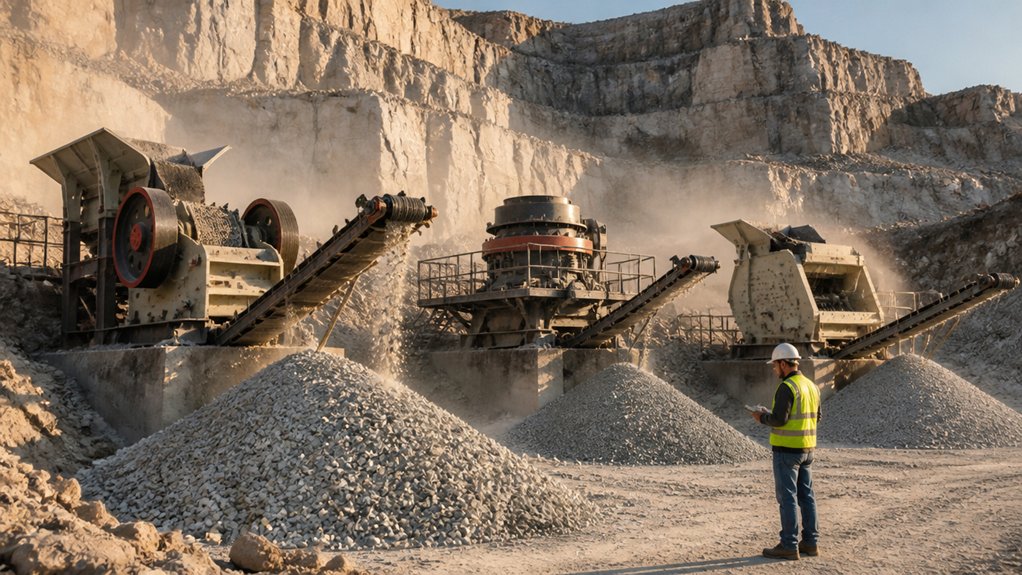
Choose a jaw crusher for large, irregular feed, a cone crusher for consistent, finer output, and an impact crusher when product shape matters. The right choice depends on the rock type, feed size, required product size, and production rate.
A jaw crusher uses compression between a fixed plate and a moving plate to break rock. It is often used as the first crushing stage, especially for hard rock. A cone crusher also uses compression, but its crushing chamber is suited to reducing material to a more uniform size. An impact crusher breaks rock by striking it with a fast-moving rotor; it can make well-shaped particles but may wear quickly on abrasive stone.
Compare the rock’s hardness and abrasiveness, which affect wear parts and replacement frequency. Moisture and clay can cause material to stick or clog, while the required output size may call for more than one crushing stage. Check the full circuit, including screens that separate material by size and conveyors that move it between machines, because their capacity can limit overall production. Purchase price alone does not show operating cost: energy use, wear parts, maintenance, and downtime also affect the economics.
How Do You Choose a Rock Crusher?

Choose a rock crusher by matching its process, feed material, and required output to the full production line. First, document the feed’s largest size, rock type, hardness, abrasiveness, and moisture, along with the required product size and production rate. These details help determine whether a jaw, cone, impact, or other crusher is suitable; the choice depends on the material and whether the job is primary or later-stage crushing.
Check how the crusher will work with screens, conveyors, and storage. A screen separates material by size, while a conveyor moves it between stages. Either can limit output, so compare the line’s capacity rather than relying on a crusher’s rated throughput alone. Ask for performance data using material similar to the feed at your site.
Compare operating demands as well as purchase specifications. Review energy use, wear-part life, maintenance access, parts availability, controls, safety provisions, warranty terms, and expected downtime. These factors drive cost per ton and can change with rock type, operating hours, and maintenance practices.
Before selecting a machine, verify the assumptions against a site trial or a reference installation processing comparable material. Check that the proposed setup can meet the required product size and production rate under realistic operating conditions.
How Do Jaw, Cone, and Impact Crushers Compare?
Jaw crushers handle primary reduction, cone crushers refine material through compression, and impact crushers break it with high-speed blows. The right choice depends on the feed size, material hardness and abrasiveness, target product size, and required shape.
A jaw crusher accepts large pieces and produces a coarse, irregular product. Compare its capacity, reduction ratio—the change from feed size to product size—and energy use at the planned settings. A cone crusher often follows a jaw crusher. It uses continuous compression to make a smaller, more consistent product; check capacity, particle-size distribution, and how quickly liners wear. Liners are replaceable surfaces inside the crusher.
An impact crusher uses rotating blow bars to fracture material. It can produce well-shaped particles, but may also create more fines, or small particles. Its suitability depends on the material’s resistance to wear and the required product shape. Compare output rate and wear-part use under the intended operating conditions.
For a fair comparison, use the same feed material, settings, and sampling period. Track tonnes per hour, kilowatt-hours per tonne, downtime, and saleable yield—the share of output that meets the product specification.
Which Crusher Fits Your Rock and Product?
Choose the metal and fabrication process based on the part’s loads, environment, geometry, and required finish. For a structural bracket made from carbon steel, laser cutting can produce the flat profile, followed by press-brake forming, which bends sheet metal with a punch and die. For a corrosion-resistant enclosure, stainless steel may be a better fit; specify the grade and surface finish because they affect corrosion resistance, appearance, and welding requirements.
State the material grade, thickness, finished dimensions, hole locations, and any critical tolerances on the drawing. A tolerance is the permitted variation from a dimension. Identify the joining method, such as TIG welding (a process that uses a non-consumable tungsten electrode), and mark weld locations and finish requirements. The best process depends on part shape, production quantity, material thickness, and whether the part needs to carry a load or resist heat, moisture, or chemicals.
Check the delivered work against the drawing and material documentation. Verify dimensions, hole positions, bends, weld locations, and visible surface defects. For critical features, specify how they should be measured and which dimensions may vary; this helps prevent disagreements over acceptance.
How Do Crusher Costs and Throughput Compare?
Compare fabrication processes by the work each can complete per shift, using the same material, thickness, part geometry, and quality requirements. Laser cutting can produce detailed profiles in sheet metal, while waterjet cutting avoids heat-affected edges but may take longer. Press-brake forming bends sheet into parts; its throughput depends on bend count, tooling changes, and handling. Welding adds time for joint preparation, fit-up, and inspection.
Compare the full production burden, not machine speed alone. Include programming, setup, material handling, tooling, consumables, finishing, inspection, and expected rework. For example, a laser-cut part made from 0.125-inch (3.2 mm) 304 stainless steel may need deburring, while a welded assembly in the same grade may require cleaning and checks for distortion. The best process depends on the drawing, material grade, thickness, tolerances, finish, and order volume.
Ask for a process plan that identifies these steps and the assumptions behind the quoted cycle time. Compare estimated labor and machine time per accepted part, including changeovers and inspection, rather than parts per hour in isolation. This shows whether the proposed method can meet production needs without shifting cost into finishing or rework.
How Will a Crusher Affect Output and ROI?
A fabrication process affects return on investment (ROI) through the usable parts it produces, not its rated speed alone. Track accepted parts per shift, machine availability, material yield, and energy use. Material yield is the share of the starting stock that becomes usable parts. These measures show whether cutting, forming, or welding meets the drawing or creates scrap, rework, and delays.
Match the process to the alloy, grade, thickness, part geometry, and required finish. For example, laser cutting stainless steel sheet, press-brake forming carbon steel plate, and welding aluminum each place different demands on equipment, tooling, and operator skill. A mismatch can restrict production or require extra finishing, even when a machine’s rated capacity appears sufficient. Check that downstream steps, such as deburring, machining, or coating, can handle the planned output.
Measure cost per accepted part, including material waste, labor, tooling, energy, maintenance, and rework. Compare that figure with the part’s business value and the production volume the process can reliably support. Model expected output using the actual drawing, material specification, tolerances, and inspection requirements; these determine whether higher throughput improves ROI or simply increases rejected work.
Frequently Asked Questions
What Permits Are Required to Install a Rock Crusher at a Quarry?
Installing a rock crusher at a quarry may require air-quality, stormwater, land-use, and operating permits. The exact approvals depend on the quarry’s location, the crusher’s capacity and emissions, and whether the equipment is fixed or mobile.
An air-quality permit may be needed for emissions from the crusher, engines, and material-handling equipment. Dust controls, such as water sprays or enclosures, may also be required. Stormwater permits can apply when runoff from the site could carry sediment or other pollutants into waterways.
Land-use approval depends on local zoning and whether quarry operations are allowed at the proposed location. Operating permits may set conditions for noise, hours, inspections, or pollution controls. Requirements can differ between state and local regulators, so the quarry’s existing approvals may not cover a new crusher or a change in production.
Check permit conditions before installation or operation. Relocating a crusher can require new approvals if the move changes the emissions source location, site drainage, land-use status, or operating conditions.
How Often Should Crusher Wear Parts Be Inspected and Replaced?
Inspect crusher wear parts at least daily, then follow the crusher manufacturer’s schedule and base replacement on operating hours and measured wear. Liners are replaceable plates that protect the crusher chamber; jaws are the crushing plates in a jaw crusher; blow bars strike material in an impact crusher.
Check for uneven wear, cracks, loose fasteners and changes in product size or throughput. Record measurements at the same points each time so operators can track wear against the limits in the manufacturer’s manual. The inspection method and replacement limit depend on the crusher model, wear-part material, feed size and abrasiveness, and operating conditions.
Replace a part when it reaches the manufacturer’s stated wear limit, or earlier if damage could affect safe operation or cause secondary damage. Do not rely on appearance alone: some wear patterns can reduce crushing performance before a part looks close to worn out. Follow the manufacturer’s shutdown and lockout procedure before inspecting or measuring parts inside the crusher.
What Safety Measures Protect Workers During Crusher Maintenance?
Protect workers during crusher maintenance by isolating every energy source, confirming the equipment cannot start, and securing parts that could move or fall. Lockout/tagout means applying locks and warning tags to energy-isolating devices; workers should verify isolation using the site’s approved procedure before opening guards or entering the machine.
The procedure should cover electrical power, hydraulic and pneumatic pressure, stored energy in springs or flywheels, and material that could shift in the crusher or feed system. Drain or release stored pressure where required, and use rated blocks or restraints to support components. Never rely on a control switch or an emergency stop as an energy isolator.
Require task-appropriate personal protective equipment (PPE), such as eye, hearing, hand, and head protection. Use fall protection when work at height creates a fall hazard, following applicable site rules and regulations. A maintenance permit should identify the equipment, isolation points, hazards, and responsible workers. Before restart, account for personnel and tools, replace guards, and inspect the machine; only authorized workers should remove their locks under the site’s lockout/tagout procedure.
Can a Crusher Be Relocated Easily Between Quarry Sites?
A mobile crusher can be moved between quarry sites, but how easily depends on its chassis, transport limits, and the work needed to prepare it at each site. A tracked crusher can often move around a quarry under its own power; moving it between sites usually requires a low-bed trailer, a trailer with a low deck for tall or heavy equipment.
Before transport, check the crusher’s operating and transport dimensions and weight against the trailer’s capacity and the route’s bridge limits, road restrictions, and turning space. Oversize or overweight loads may require permits or an escort, depending on local rules.
Also check what must be removed or secured for travel. Feed hoppers, conveyors, guards, or other components may need to be folded, detached, or fastened, and the manufacturer’s transport instructions should guide this work. At the destination, allow time and access for unloading, setup, and connection to power or other equipment if required. The relocation plan therefore depends on the crusher model, distance, route, site access, and the preparation and commissioning work specified by its manufacturer.
What Training Do Operators Need Before Using a Rock Crusher?
Before operating a rock crusher, operators need equipment-specific instruction on its controls, safe feed limits, lockout/tagout, emergency stops, and procedures for clearing blockages. Lockout/tagout means isolating and securing energy sources so machinery cannot start during servicing.
Training should match the crusher model and the material being processed. Operators need to know how feed size, material hardness, and moisture affect operation, and how to recognize hazards such as moving parts, falling material, dust, and unexpected machine movement. The manufacturer’s operating and maintenance manuals are the primary sources for machine-specific limits and procedures.
Before work begins, a supervisor should verify that each operator can start, run, and shut down the crusher safely, respond to an emergency, and follow the approved blockage-clearing procedure. Operators also need instruction on routine inspections, including checking guards, belts, and other components identified in the manual. The required training and verification depend on the machine, site hazards, and applicable workplace safety rules.