
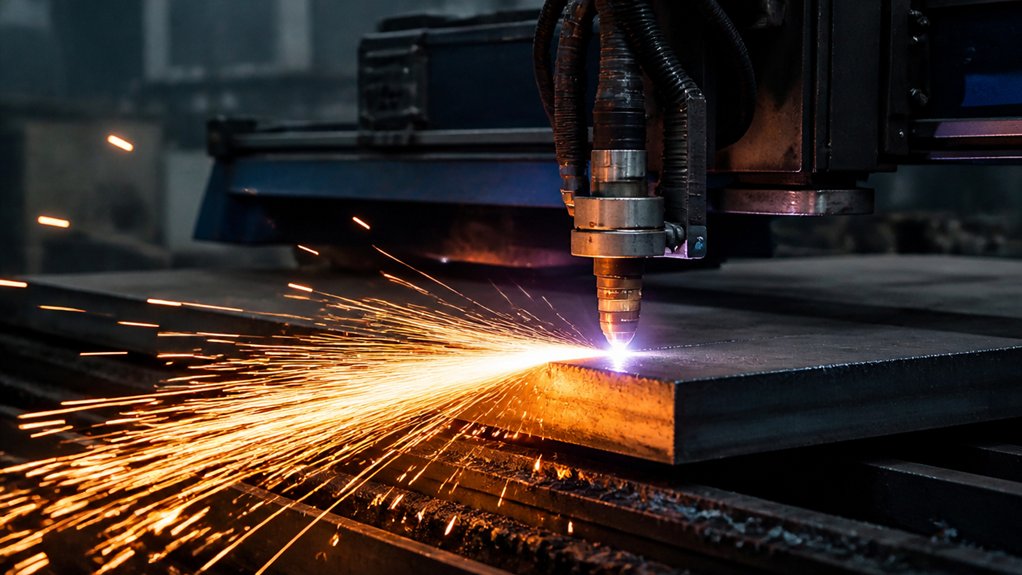
Laser, plasma, and waterjet cutting suit different plate jobs; the right choice depends on material, thickness, edge requirements, and later machining or finishing. For carbon-steel plate, laser cutting often suits detailed profiles and narrow kerfs, the width of material removed by the cut. Plasma cutting can be a practical choice for thicker plate or less demanding edge requirements, while waterjet cutting avoids heat-related changes because it cuts with a high-pressure stream of water and abrasive.
Each process has trade-offs. Laser and plasma use heat, which can leave a heat-affected zone: material near the cut whose properties or structure have changed. Waterjet avoids that zone but may cut more slowly, and its abrasive stream can leave a different edge texture. Actual cut quality depends on the machine, material grade, thickness, and settings, so a drawing should state which edges need to remain as cut and which require machining.
The machine rate is only one cost driver. Setup, part layout (nesting), material utilization, piercing time, edge cleanup, and secondary operations can affect the finished part’s cost. When requesting or reviewing a quote, specify the material grade, plate thickness, profile, quantity, critical dimensions, and edge-finish requirements.
How Do the Three Plate-Cutting Methods Compare?
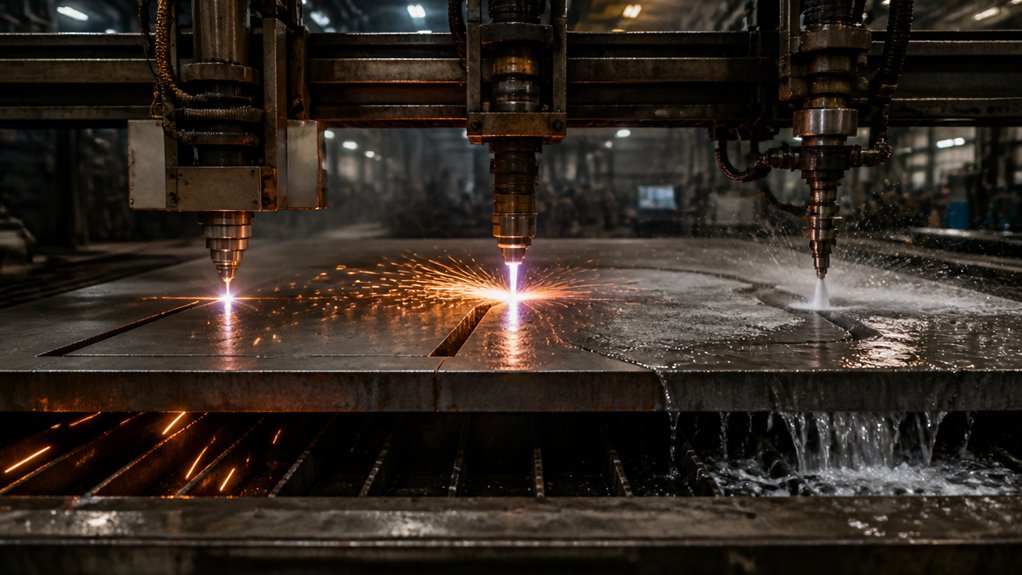
Laser cutting suits detailed parts in thin-to-medium plate; plasma cutting is often a practical choice for thicker conductive metals; waterjet cutting is useful when heat could distort the material or when the workpiece isn’t suitable for thermal cutting. The best fit depends on the metal, thickness, required edge quality, production volume, and drawing tolerances.
A laser concentrates light to melt or vaporize material, producing a narrow cut, called a kerf, and often a clean edge. It commonly cuts carbon steel, stainless steel, and aluminum, but performance depends on thickness, alloy, and machine capability. Plasma uses an electrically charged gas to cut conductive metals such as steel and aluminum. It can handle thicker plate, but its wider kerf and heat-affected zone—the area changed by cutting heat—may mean more edge cleanup. Waterjet uses a high-pressure stream of water, often mixed with abrasive particles. Because it doesn’t heat the workpiece substantially, it can cut heat-sensitive alloys and nonmetals, though cutting may take longer and abrasive use adds operating cost.
When comparing bids, check the specified material grade, thickness, tolerance, edge condition, and any required secondary work. Compare setup, consumables, throughput, scrap, and finishing—not machine rate alone—and avoid paying for tighter tolerances than the part requires.
How Do Laser, Plasma, and Waterjet Cutting Work?
Laser cutting uses a focused beam to melt or vaporize metal; plasma cutting melts it with an electrically charged gas; waterjet cutting erodes it with a high-pressure water stream, usually mixed with abrasive. Each process follows a programmed profile, but its energy source affects the edge, heat exposure and suitable materials.
For example, a laser can cut carbon steel, stainless steel and aluminum sheet. Assist gas clears molten material from the cut, called the kerf. Plasma uses an electric arc to turn gas into plasma, a hot, electrically conductive state. It cuts electrically conductive metals such as carbon steel and aluminum, including thicker plate, but the cut edge may need more cleanup. Waterjet cutting can shape metal without heat, which helps avoid heat-related changes near the edge. Its abrasive stream can cut materials such as stainless steel and aluminum.
The right process depends on alloy, thickness, required edge quality, part geometry and production volume. Ask the supplier to confirm the material grade, thickness, cut-edge condition and any required secondary work. Cost depends on factors such as cutting time, material handling, abrasive use and the complexity of the programmed path.
What Drives Plate-Cutting Costs?
Plate-cutting cost depends on the cutting process, material, part geometry and order size. For example, fiber-laser cutting can process thin carbon steel quickly, while thick plate may require slower cutting or a different process, such as plasma or waterjet cutting. The suitable method depends on the alloy, thickness, edge requirements and available equipment.
Material grade affects how a process cuts. Reflective aluminum can be harder to cut with some laser systems than carbon steel, and stainless steel may need different settings to achieve the required edge. The mill finish—the surface condition supplied by the mill—can also affect cutting and appearance. Provide the exact alloy and grade, thickness, and any requirements for the cut edge.
Part geometry shapes machine time. Total cut length, the number of pierces (points where the cutting tool starts through the plate), small features and bevels can add time. Tight tolerances, meaning narrow limits on allowable dimensional variation, may require slower cutting or extra inspection. Setup and programming also contribute, especially for short runs; repeat orders can spread those tasks across more parts. Efficient nesting, or arranging parts to use the plate with less scrap, can reduce material waste. Compare quotes against the same drawing, material, quantity, edge quality and finishing scope.
Which Plate-Cutting Method Fits Your Job?
Choose laser cutting for thin or medium-thickness carbon steel, stainless steel or aluminum parts that need precise profiles and clean edges. The best fit depends on the alloy, plate thickness, drawing tolerances and production volume. A kerf is the width of material removed by the cut; its size and the resulting edge quality vary with the laser, material and cutting settings.
Choose plasma cutting for thicker carbon steel profiles when speed and lower process cost matter more than a narrow kerf or minimal edge cleanup. Plasma uses an electrically charged gas to cut metal, and the cut may leave a wider kerf or a rougher edge than laser cutting. Include any deburring or machining needed to meet the drawing in the process comparison.
Choose waterjet cutting when heat could distort a part or change a heat-sensitive alloy, coating or material property. Waterjet uses a high-pressure stream of water, often mixed with abrasive, so it cuts without creating a heat-affected zone—the area beside a cut whose properties may change from heat. Its suitability depends on thickness, required edge quality and cutting time; abrasive use and slower cutting can add cost.
When briefing a supplier, specify the alloy and grade, plate thickness, profile tolerances, edge requirements and quantity. Compare setup, cutting, consumables and secondary work, not machine capacity alone.
Frequently Asked Questions
Can Cut Plate Edges Be Welded Without Additional Preparation?
Some cut plate edges can be welded without beveling, but only when the joint design and welding procedure allow it. A bevel is an angled edge prepared to help the weld reach the required depth; it is not necessary for every joint.
For carbon-steel plate joined by gas metal arc welding (GMAW), a square edge may suit a thin, full-penetration butt joint if the approved procedure specifies it. A butt joint joins two pieces edge to edge. Plasma-cut or laser-cut edges may be suitable after removing slag, dross, and oxide, which can interfere with fusion. Oxyfuel-cut edges may need more cleanup if they have heavy scale or unevenness.
The decision depends on the steel grade, plate thickness, joint access, required weld strength, and applicable drawing or welding code. Stainless steel and aluminum also have different requirements for oxide removal and heat control. The welding procedure specification (WPS)—the document that sets the approved joint preparation and welding parameters—should state whether the edge can remain square and what cleaning is required.
Before production, check that the cut edge is sound and free of oil, paint, rust, and loose residue. Require a bevel when the drawing, WPS, or governing code calls for one.
How Should Cut Plates Be Stored to Prevent Corrosion?
Store cut steel plates indoors in a dry, covered area, raised off concrete floors and away from standing water. Moisture trapped against steel can cause rust, while concrete can hold moisture and transfer it to the plate.
Keep plates separated with clean, dry spacers so air can circulate and water does not collect between surfaces. Avoid wood or other materials that may retain moisture or transfer contaminants. Do not stack plates where their weight could damage edges or coatings.
For carbon steel, apply a compatible rust-preventive coating if plates will be stored for an extended period or exposed to humid conditions. Check that the coating will not interfere with later welding, painting, or other finishing; remove it where the fabrication process requires clean metal. Stainless steel and aluminum also need clean, dry storage, but keep them separate from carbon steel to reduce contamination from iron particles.
Inspect stored plates regularly for condensation, rust, damaged coatings, or trapped debris. Storage requirements depend on the metal grade, surface finish, coating, storage duration, and planned fabrication process.
What File Formats Should I Submit for a Plate-Cutting Order?
For a flat plate profile cut by laser or plasma, submit a clean DXF or DWG file; for a three-dimensional part, submit a STEP file, a format that represents a part’s shape and geometry. Confirm the file type with the cutting supplier, because accepted formats and import settings vary by machine and software.
State the units, material grade, plate thickness, and quantity in the drawing or accompanying order documents. For example, specify whether the part is 1/4 inch (6.35 mm) carbon steel or 1/8 inch (3.18 mm) 304 stainless steel; do not rely on the file alone to identify the material. Include finished dimensions and identify holes, slots, bends, and any edges that need a particular finish.
Before sending the file, remove duplicate lines and overlapping profiles, which can cause unintended repeat cuts. Check that contours are closed where the cutting software requires closed shapes, and distinguish cut lines from markings or reference geometry. Requirements depend on the process: laser cutting may need details about small features or reflective material, while plasma cutting may need guidance on lead-ins, pierce points, and edge quality. Confirm those details with the supplier before release.
Can Plate Cutting Services Arrange Delivery to My Site?
Yes, many plate-cutting services can deliver cut steel, aluminum, or stainless-steel plate to a business site. Availability depends on the supplier’s delivery area, the order size, and the vehicle needed for the plate’s dimensions and weight.
Before placing the order, confirm the delivery address, access restrictions, delivery window, and who will unload the plate. A forklift or crane may be needed, depending on the load and the site’s equipment. Ask whether the driver can unload or whether your staff must handle it.
Specify how the plate should be stacked and protected during transport, especially if cut parts have finished surfaces or sharp edges. Confirm that the delivery paperwork identifies the material grade, thickness, and cut parts so the receiving team can check them against the purchase order. Delivery normally covers transport, not installation or movement to the final work area; clarify those responsibilities before approving the order.
What Tolerances Should I Specify on a Plate-Cutting Drawing?
Specify tolerances only for features that affect fit, alignment, sealing, or function. On a plate-cutting drawing, identify the required finished dimensions, hole locations, and squareness—the condition in which adjacent edges meet at a right angle. The needed limits depend on the part’s mating components and the cutting process, such as laser, plasma, or waterjet cutting.
State the material by type and grade, such as ASTM A36 carbon steel, and give the nominal thickness in inches (millimetres). Identify the cutting process if it is specified, because each process can leave different edge conditions and dimensional variation. Do not assume that a machine’s advertised capability is the right tolerance for every feature; confirm requirements against the selected process and material thickness.
Use a clear datum, or reference edge or surface, for dimensions and hole locations. Specify edge preparation, such as deburring or a bevel for welding, only where the part requires it. Tighter tolerances can require slower cutting, extra setup, inspection, or secondary machining, so reserve them for features that need them.