
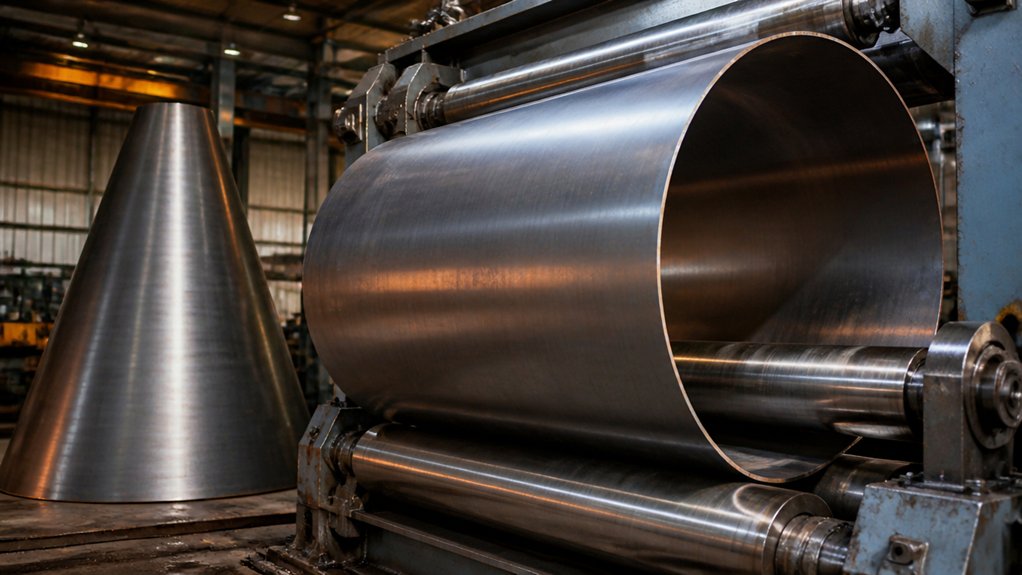
Plate rolling forms heavy cylinders and cones by passing plate between rolls that bend it in controlled stages. Flat spots can result from inadequate prebending, uneven roll pressure, poor edge preparation, or a machine that cannot handle the plate’s thickness, width, and material strength.
Before production, specify the material grade, plate thickness and width, finished diameter, and whether the part is cylindrical or conical. For example, a drawing for a cylinder made from ASTM A36 carbon steel should state the required inside or outside diameter and identify which surface controls the dimension. ASTM A36 is a material specification; it does not by itself define the rolling tolerance.
Ask the fabricator to confirm that the machine’s capacity and roll arrangement suit the job. Prebending—the initial bending of plate edges to reduce the flat sections at a seam—depends on the machine and the required finished shape. For a cone, the setup must also account for the difference in circumference between its large and small ends.
Check the drawing for seam location, edge condition, and dimensional tolerances. Tolerances are the permitted variation from a specified dimension, and the appropriate limits depend on the part’s fit and function. Ask how roundness and end diameter will be checked after rolling.
Set Up a Plate Roll for Heavy Stock
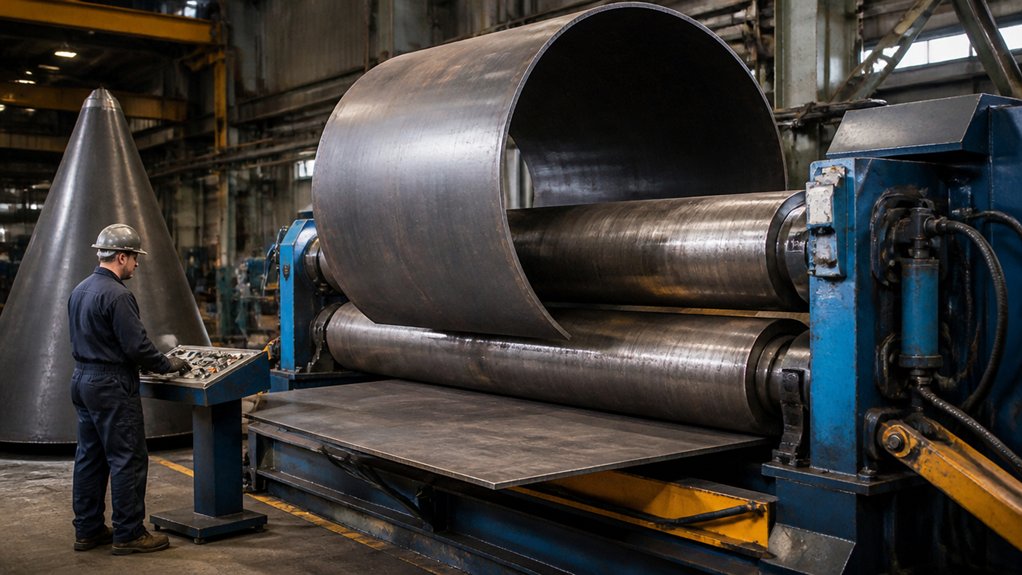
Before rolling heavy plate, confirm that the plate roll’s rated capacity covers the material’s thickness, width, strength, and required finished diameter. Capacity depends on the machine’s roll arrangement and the material’s properties, so check the manufacturer’s capacity chart for the specific job rather than relying on a general rating.
Ask the fabricator to verify the roll configuration, drive, and hydraulic system, then set the lower rolls and top-roll pressure according to the machine manufacturer’s instructions. The top roll applies pinch pressure, which holds the plate against the lower rolls; uneven pressure can cause the plate to track off center or form unevenly. If the plate has a beveled edge, account for the reduced contact area and any forming allowance in the setup.
Center the plate using the machine’s alignment references. Use rated lifting equipment to support heavy plate and prevent it from twisting during loading. Confirm that guards, emergency stops, and controls function, and keep hands clear of pinch points. Feed the plate in a straight, controlled path. Make a light test pass, inspect alignment and curvature, and adjust the settings gradually before applying full forming pressure.
Prepare Plate Edges to Prevent Flat Spots
To prevent flat spots at a cylinder seam, prebend both plate ends to match the cylinder’s specified inside radius. Prebending is the forming step that curves each end before the plate passes through the main rolling operation. It reduces the straight sections that can otherwise remain where the plate edges meet.
Before forming, identify the plate material, grade, thickness, and condition from the job documents or material certificate. Check that the roll machine and tooling are suitable for that material and thickness; the required setup depends on the plate’s properties, the cylinder radius, and the machine’s capacity. Inspect both ends for burrs, notches, or other damage, and remove defects that could affect fit or start a crack. Clean off scale, oil, and debris that could interfere with contact or measurement.
Specify that the prebend must extend evenly across the full plate width. After forming, compare each end with the specified profile using a template or radius gauge, a tool that checks curvature. If either end remains too straight, correct the prebend before rolling the cylinder. Don’t assume the main rolling pass will remove a flat section at the seam.
Roll Cylinders With Even Plate-Rolling Passes
For plate rolling, keep the feed direction, speed, and roll pressure consistent from pass to pass. A pass is one movement of the plate through the rolls; steady, slightly overlapping passes help form a uniform curve and reduce flats or ridges.
Start with a light roll setting and advance the plate in small, controlled increments. Watch both edges as the plate exits: if one edge leads, stop and check alignment before continuing. A developing radius—the curve measured from the center of the circle to the plate—can be checked with a template or gauge. Adjust pressure gradually between passes, based on the required radius and the plate’s material, grade, thickness, and width.
Do not try to form thick or uneven plate in one heavy pass. Smaller increments reduce the risk of uneven bending and help the operator keep the plate aligned. Record the feed and pressure settings for each pass so the process can be repeated. Use lubricant only if the roll-machine manufacturer and material specifications allow it; lubricant on the rolls or plate can cause slippage.
Adjust the Rolls to Form a Cone
Form a cone by setting the plate rolls so the plate’s wide end travels farther than its narrow end. This difference in travel creates the taper, or gradual change in diameter. The required setting depends on the cone’s large and small diameters, the plate’s width and thickness, its material grade, and the roll machine’s capacity.
Before production, ask for the roll manufacturer’s setup chart or calculation method for the specific machine and job. The upper roll is the main forming roll; supports may also be adjusted to create the required slope. Align the plate against the side guide, a reference that keeps the plate square to the rolls, and check that the rolls are aligned across the working width to prevent twisting.
Start with a light pass, with the narrow end on the lower side of the setup. Increase pressure gradually and reposition the plate between passes as needed to maintain the taper. Keep the feed steady and stay within the machine’s rated load. For a purchase or production brief, specify the cone’s end diameters, height, plate material and grade, thickness, and required fit-up; the setup also depends on the machine and forming sequence.
Inspect the Shape and Fix Rolling Defects
Check a rolled cone’s profile, roundness, and seam alignment against the drawing before making another pass. Profile is the cone’s side shape; roundness is how closely each end matches a circle. Set the cone on a level surface and compare both ends with the specified diameters and shape.
Use a template, straightedge, or radius gauge to find gaps, lobes, or flat spots. A lobe is a section that bulges beyond the intended circle. Check that the seam edges meet evenly, and measure any gap against the drawing or the project’s acceptance criteria. The required limits depend on the material, thickness, cone dimensions, and intended fit.
If the cone’s axis twists, check alignment between the rolls and guides before trying to correct the shape. For a localized flat spot, make a short, controlled pass with that area under the forming roll. Avoid overbending the whole cone to correct one defect, since this can distort the profile or open the seam. Inspect for scuffing or heat marks, then review the lubricant and roll contact pressure specified for the material. Make small adjustments and remeasure after each pass. Stop when the measured shape and seam meet the drawing’s requirements.
Frequently Asked Questions
What Safety Gear Should Operators Wear When Using a Plate Roll?
Plate-roll operators should wear close-fitting safety gloves, eye protection, and safety footwear; add hearing protection when noise levels or site rules call for it. Gloves should fit snugly and stay clear of rotating rolls, which can catch loose material or clothing. Eye protection helps guard against metal chips and sharp edges.
The required gear depends on the machine, material, and workplace hazards. For example, handling sheet steel with sharp edges may call for cut-resistant gloves, while noisy production areas may require hearing protection under the site’s safety program. Safety footwear helps protect against dropped stock and heavy parts.
Operators should receive training on the plate roll and its safeguards before use. Lockout/tagout—a procedure for isolating energy and marking equipment so it cannot be restarted—must be followed before maintenance or clearing a jam. Personal protective equipment does not replace machine guarding or safe operating procedures.
How Do You Choose Between a Three-Roll and Four-Roll Machine?
Choose a three-roll machine for occasional, straightforward rolling of plate or sheet; choose a four-roll machine when production needs faster loading, more controlled pre-bending, or repeatable parts. Pre-bending is the operation that curves a plate edge before the main rolling pass.
A three-roll machine can suit work where operators can handle the extra positioning steps and part volumes are modest. A four-roll machine uses a powered lower roll to grip and position the material, which can reduce handling between pre-bending and rolling. The benefit depends on the machine’s controls, roll arrangement, and the part’s geometry.
Specify the material grade, thickness, width, finished diameter, and edge condition when comparing machines. For example, rolling 1/4-inch (6.35 mm) ASTM A36 plate into a large cylinder presents different demands from forming thin stainless-steel sheet into a tight radius. Check the manufacturer’s capacity data for the exact material and width; nominal capacity alone may not reflect the required pre-bend or diameter.
Also compare operator skill requirements, setup time, and expected part volume. Roll alignment—the positioning of the rolls relative to one another—matters on either machine because misalignment can affect roundness and produce uneven edges. Cost depends on capacity, controls, automation, and the amount of handling the process requires.
What Material Properties Affect Plate-Roll Capacity?
Plate-roll capacity depends on the material’s yield strength, ductility, tensile strength, and work-hardening behavior. Yield strength is the stress at which metal begins to deform permanently; higher yield strength generally requires more rolling force and can reduce the maximum thickness a machine can form. Ductility is a material’s ability to deform without cracking, so low-ductility plate may need a larger roll diameter or a different forming sequence.
Tensile strength is the stress a material can withstand before it breaks. It helps indicate forming loads, but it does not predict capacity on its own. Work hardening occurs when forming makes metal stronger and less ductile; it can increase the force needed during later passes. Rolling direction also matters because plate properties can differ along and across the direction in which the plate was rolled.
For a plate-roll specification, identify the material grade, thickness, width, and required finished diameter. Capacity depends on all four, as well as the machine’s roll geometry and the number of rolls. For example, a machine’s stated capacity for mild-steel plate should not be assumed to apply to stainless steel or high-strength steel. Ask the machine manufacturer to confirm capacity for the specified material and forming conditions.
How Often Should a Plate Roll Be Maintained and Calibrated?
Inspect a plate roll at the start of each shift, and follow the manufacturer’s maintenance schedule; calibrate it at the interval the manufacturer specifies. A shift inspection can reveal loose fasteners, hydraulic leaks, damaged guards, or debris before they affect plate rolling or create a safety risk.
Maintenance needs depend on the machine’s design, operating hours, workload, and the materials being rolled. For example, frequent rolling of thick carbon-steel plate can put different demands on rolls and drive components than occasional rolling of thin aluminum sheet. Use the manufacturer’s instructions for lubrication, wear checks, and replacement parts rather than applying a single schedule to every machine.
Calibration checks whether the machine’s settings and measurements match known references. Ask the manufacturer or a qualified service provider to define the calibration method and interval for the machine and the required rolling accuracy. Recheck calibration after repairs to measurement or control systems, an overload, or signs of accuracy drift. Record inspections, maintenance, and calibration results so production staff can identify recurring problems and verify that the machine is suitable for the specified material and thickness.
When Is Heat-Assisted Rolling Appropriate for Heavy Plate?
Heat-assisted rolling is appropriate when a plate cannot be formed to the required radius by cold rolling without exceeding the machine’s capacity or the material’s forming limits. Cold rolling shapes metal without deliberate heating; heat-assisted rolling warms the plate before or during forming to reduce its resistance to bending.
The decision depends on the alloy and grade, plate thickness, bend radius, rolling equipment, and required properties after forming. For example, a thick plate of carbon steel may need a different approach from a thinner plate of stainless steel. Heating does not make every grade easier or safer to roll, and excessive or uneven heat can cause distortion, cracking, or changes to strength and hardness.
Before specifying the process, ask the fabricator to confirm the material grade, heating method, temperature controls, and qualified procedure. Also check whether the plate needs post-forming heat treatment, inspection, or mechanical testing to verify that it still meets the drawing and material specification. The required checks depend on the grade, service conditions, and applicable project standards.